Thermal transfer labels are labels designed to receive a printed image from a ribbon using a heated printhead. They are widely used for barcodes, serial numbers, product identification, and industrial traceability.
The term describes the printing method, not a single label material. Thermal transfer labels can use paper, polyester, polypropylene, polyimide, or other compatible constructions.
Their durability depends on the complete combination of label surface, ribbon, adhesive, printer settings, and application conditions. Choosing a durable film alone does not guarantee that the printed information will remain readable.
How Thermal Transfer Labels Work
The Printhead Transfers the Ribbon Image
During printing, the printer positions the ribbon between the printhead and the label. Controlled heat transfers the ribbon’s imaging material onto the label surface.
The printer creates text, graphics, and barcodes by heating selected elements across the printhead.
A compatible printable coating helps the image form correctly. Ribbon formulation, print speed, and heat settings must suit the label and printer.
Thermal transfer does not mean that the finished label must be heated to attach it. Many industrial labels use pressure-sensitive adhesive, although other label and tag constructions also exist.
Thermal Transfer vs Direct Thermal
Both methods use a thermal printhead, but they form the image differently.
| Comparison | Thermal transfer | Direct thermal |
| Image formation | Transfers imaging material from a ribbon | Activates a heat-sensitive coating on the media |
| Ribbon required | Yes | No |
| Material options | Compatible paper and synthetic constructions | Specially formulated direct thermal media |
| Durability considerations | Depends on the material–ribbon combination | Depends on the direct thermal coating and protection |
| Typical selection reason | Identification requiring a qualified level of print durability | Applications suited to ribbon-free printing and the media’s service limits |
Direct thermal can be suitable for many short-life applications. Thermal transfer is often selected when the label must withstand more demanding handling or exposure.
For a printer-manufacturer explanation, see Zebra’s overview of thermal printing technologies.
Common Thermal Transfer Label Materials
Paper Labels
Paper is a practical option for indoor identification where demanding chemical, moisture, or abrasion resistance is not required.
Typical uses include cartons, inventory labels, and general warehouse identification.
Coatings and adhesive choices change performance, so “paper label” is not a complete specification. Confirm whether the application involves condensation, repeated handling, or cleaning.
Polyester and Polypropylene Labels
Polyester, commonly called PET, is frequently considered for durable identification. Suitable constructions can provide dimensional stability and resistance to handling and selected environmental exposures.
Polypropylene, or PP, is another synthetic option. It may be appropriate where moisture resistance, flexibility, or packaging requirements influence selection.
Neither material name guarantees a particular temperature rating, outdoor life, or chemical resistance. Those properties depend on the complete product construction.
Polyimide Labels
Polyimide is commonly considered for demanding electronics processes, including applications involving elevated temperatures.
However, temperature alone is insufficient for selection. Exposure duration, repeated cycles, cleaning chemicals, adhesive behavior, and print readability must all be reviewed.
GAOFE’s polyimide circuit board labels provide a relevant product starting point. Confirm the selected grade and complete process profile before approval.
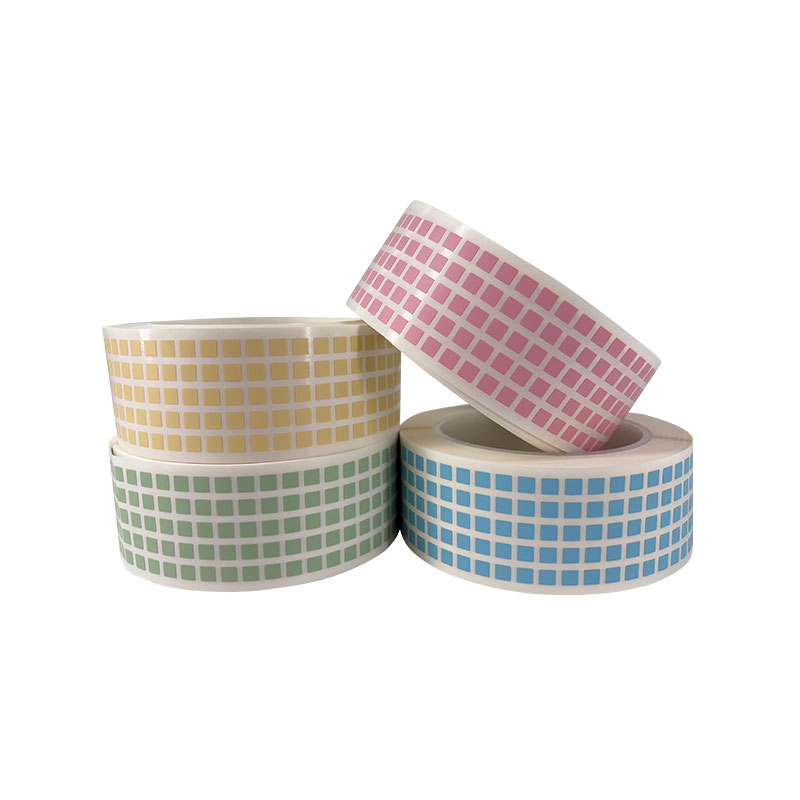
Label color and format can support identification, but they do not establish temperature or chemical performance.
Adhesive, Topcoat, and Liner Also Matter
The face material is only one layer of the label.
| Construction element | Main selection question |
| Face material | Will it retain its required physical properties? |
| Printable coating | Is it compatible with the ribbon and printing conditions? |
| Adhesive | Will it bond to the actual surface throughout the required exposure? |
| Release liner | Will it dispense correctly in the intended printer or applicator? |
| Printed image | Will text and barcodes remain readable after use? |
A label can fail even when its film remains intact. Edge lifting, adhesive softening, print removal, or poor dispensing may make it unsuitable.
What Determines Thermal Transfer Label Durability?
Match the Ribbon to the Label
The main ribbon families are wax, wax-resin, and resin.
| Ribbon family | Common selection direction | What to verify |
| Wax | Suitable paper labels and less demanding exposure | Print quality and handling resistance |
| Wax-resin | Selected paper and synthetic materials | Coating compatibility and required durability |
| Resin | Compatible synthetics and demanding print-resistance requirements | Exact material pairing and exposure performance |
These are general selection directions, not guarantees for every formulation.
GAOFE’s wax ribbon range and resin ribbon range can be reviewed when preparing a printing specification.
Confirm printer compatibility, ribbon dimensions, winding, and printhead requirements. A resin ribbon intended for one printing arrangement may not suit another.
Separate Application Temperature from Service Temperature
Application temperature describes the conditions when the adhesive label is attached.
Service temperature describes the exposure after application. Short process peaks and continuous exposure are also different requirements.
Provide the actual time–temperature profile, including repeated cycles. Do not interpret a short-duration heat-resistance result as a continuous operating rating.
Test Chemicals, Moisture, and Abrasion
Specify the actual substance, concentration, temperature, contact time, and cleaning method.
“Chemical resistant” does not mean resistant to every solvent. Likewise, moisture resistance does not automatically establish suitability for immersion, sterilization, or cryogenic storage.
Abrasion testing should represent the real handling process. Evaluate both the label attachment and the printed information after exposure.
Verify Barcode Quality After Exposure
A barcode that scans immediately after printing may become unreliable after processing.
Check image contrast, damage, dimensions, and data accuracy using the applicable method. Where GS1 identification is used, the GS1 barcode verification guidelines provide relevant verification references.
Barcode verification and a successful scan are different checks. Agree on the required acceptance criteria before production.
Industrial Applications and Selection Guide
PCB and Electronics Traceability
Electronics labels may carry serial numbers, production data, and machine-readable codes through assembly and inspection.
For labels exposed to soldering or cleaning, test the complete material–ribbon–adhesive combination using the intended process.
Where static-sensitive devices are involved, define the ESD requirement separately. A thermal transfer label is not automatically an ESD-specific product.
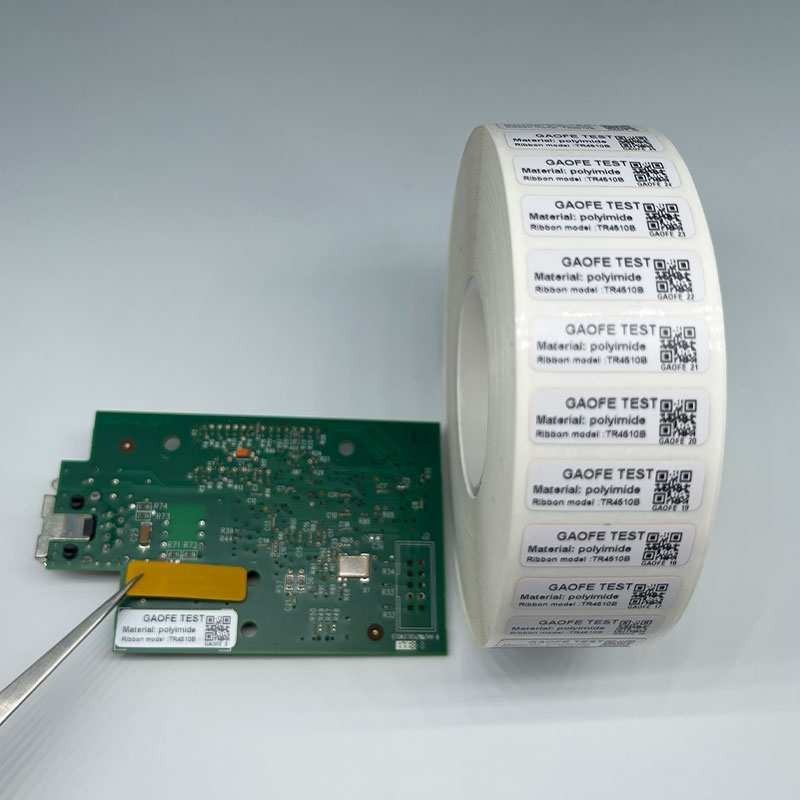
PCB identification requires readable printing and suitable adhesion throughout the intended process.
Asset, Equipment, and Warehouse Identification
Asset labels may need to remain readable through cleaning, handling, and extended service.
Warehouse labels may instead prioritize throughput, scan reliability, suitable adhesion, and compatibility with existing printers.
For curved, textured, painted, or low-surface-energy plastics, validate the adhesive on the actual item. A successful test on stainless steel does not establish performance on every substrate.
Laboratory and Cold-Storage Identification
Laboratory labels may encounter condensation, disinfectants, low temperatures, or other process conditions.
GAOFE lists chemical-resistant cryogenic laboratory labels. The selected construction, printing method, application conditions, and storage exposure should be confirmed together.
Applying a label before freezing and applying it to an already frozen container are different use cases.
Prepare a Practical Supplier Brief
| Information | Details to provide |
| Label function | Identification, traceability, warning, or another purpose |
| Application surface | Material, texture, curvature, cleanliness, and temperature |
| Exposure | Heat, chemicals, moisture, abrasion, light, and duration |
| Printing | Printer model, resolution, ribbon, speed, and variable data |
| Format | Dimensions, shape, roll core, winding, gaps, and quantity |
| Acceptance | Adhesion, readability, verification, and required documentation |
Approve samples under representative conditions before committing to a production quantity.
To discuss a label and ribbon combination, contact GAOFE with your application details. Include the substrate, exposure profile, printer model, label drawing, and expected quantity so the proposed construction can be reviewed.
FAQ
1. Do thermal transfer labels need a ribbon?
Yes. A compatible ribbon supplies the imaging material. Direct thermal media uses a different process and does not require a ribbon.
2. Are thermal transfer labels waterproof?
Not automatically. Water resistance depends on the face material, coating, ribbon, adhesive, and exposure conditions.
3. Can a direct thermal printer print thermal transfer labels?
A direct-thermal-only printer cannot perform ribbon-based thermal transfer printing. Check whether the printer supports thermal transfer mode and the required ribbon format.
4. Does resin ribbon make every label heat resistant?
No. The label film, coating, adhesive, printed image, and exposure duration must all meet the application requirements.
5. How long do thermal transfer labels last?
There is no universal lifespan. Define the intended service period and validate the construction under representative storage and operating conditions.


