The cost of electronic labels depends on the material, dimensions, printing requirements, order quantity, and application. In this guide, the term refers to physical identification labels used on electronic components, PCBs, and electronics packaging, including ESD PET labels.
These are adhesive identification labels, rather than wireless electronic shelf displays.
GAOFE’s ESD PET product page does not publish a fixed unit price. Buyers therefore need a specification-based quotation. To compare offers accurately, separate the label price from setup charges, printing consumables, delivery, and application losses.
What Does the Price Per Label Include?
Blank Labels vs Printed Labels
A blank label quotation usually covers the specified material, adhesive, liner, and converted label format. Printing may be performed later using the buyer’s equipment.
A printed-label quotation may include fixed artwork, variable information, or both. Confirm whether serial numbers, barcodes, inspection, and data handling are included.
The two prices cannot be compared directly without adding the costs that remain outside each offer.
For example, blank labels may require ribbon, printer time, setup, and inspection. Preprinted labels may still need variable data added at the point of use.
Label Price vs Delivered Cost
Ask the supplier to separate the following items:
| Cost item | What to confirm |
| Label material | Film type, thickness, coating, adhesive, and liner |
| Converting | Size, shape, die-cut layout, perforations, and roll format |
| Printing | Fixed artwork, colors, variable data, and printing responsibility |
| Setup | Tooling, artwork preparation, plates, or other one-time charges |
| Inspection | Agreed checks, documentation, and barcode verification where required |
| Packaging and delivery | Packaging, freight, and applicable destination charges |
| Buyer-side processing | Ribbon, printing labor, application, and normal losses |
Not every order includes every charge. The purpose is to establish a consistent comparison boundary.
Use the Correct Quantity Basis
Confirm whether the quoted price is per label, per thousand labels, or per roll.
A lower roll price may simply contain fewer labels. Also distinguish individual die-cut labels from sheets, continuous stock, and multi-label layouts.
For purchasing comparison:
Label unit price = quoted label-goods value ÷ number of labels supplied
Keep separately charged setup and delivery costs visible before calculating a broader unit cost.
What Changes Electronic Label Cost?
Material and Application Requirements
An ordinary identification sticker and an ESD-specific label are not equivalent specifications.
The required construction may depend on the application surface, process temperature, cleaning chemicals, expected service period, and static-control requirements.
GAOFE’s ESD PET labels for PCB and electronics assembly list PET material, model B-796G, permanent adhesive, and thermal-transfer printing.
These details provide a starting point for an inquiry. They do not establish suitability for every board process or static-sensitive application.
Dimensions, Shape, and Roll Layout
Label area influences material use, but size alone does not determine the price.
The number of labels across the web, gaps, edge waste, corner shape, and usable production width can affect converting efficiency. A small custom label can therefore cost more per piece than a larger standard format.
Core diameter, maximum roll diameter, winding direction, and labels per roll also matter when labels must work with a printer or automatic applicator.
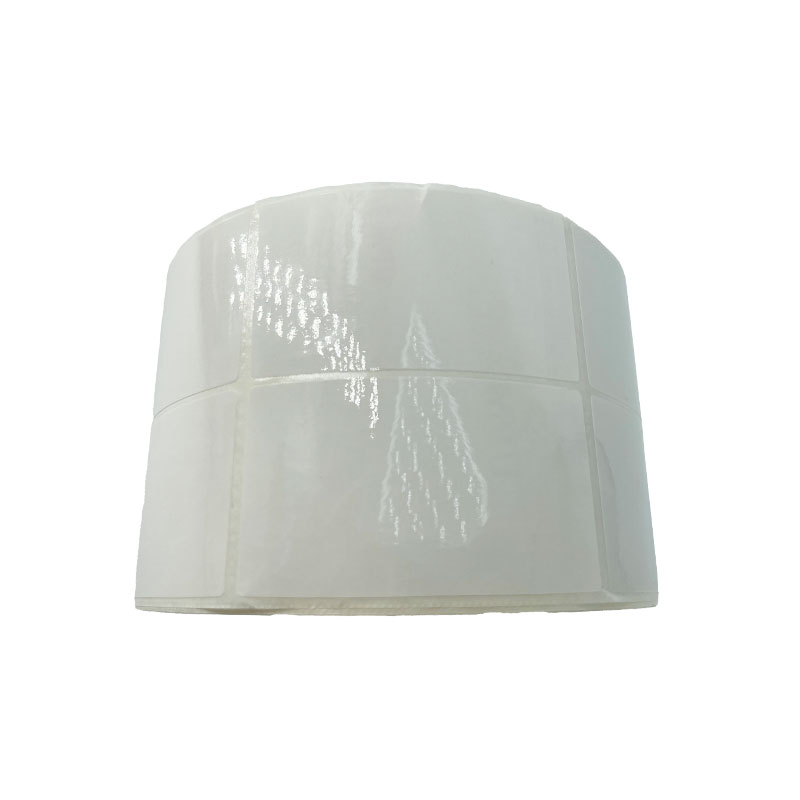
Label dimensions and roll construction should be specified before comparing unit prices.
For board-level applications, review the relevant circuit board labels and describe the actual process conditions rather than selecting by appearance alone.
Printing and Barcode Requirements
Cost depends on whether labels are blank, printed with fixed information, or supplied with controlled variable data.
Small barcodes may require a suitable combination of label surface, ribbon, printer resolution, layout, and operating settings. Printing a code that scans once is not the same as verifying its quality against an agreed requirement.
The GS1 barcode verification guidelines provide a reference for checking barcode quality and encoded-data integrity where GS1 requirements apply.
If printing in-house, include compatible resin thermal-transfer ribbons in the comparison. Confirm the exact ribbon and label combination through testing.
Order Quantity and Product Variations
Larger production runs can spread setup costs over more labels. However, the price effect depends on the material, layout, production process, and number of variations.
An order containing several sizes or artwork versions may require more setup than one large run of a single specification.
Request separate prices for the initial order and repeat orders. Confirm which setup charges recur and whether the quoted quantity allows for production tolerances.
Buying more is not automatically cheaper overall if the labels cannot be used within their approved storage period.
How to Calculate Cost Per Usable Label
A Clearly Defined Example
The following figures are hypothetical and demonstrate the calculation only. They are not GAOFE prices or market-price estimates.
| Example item | Assumed amount |
| Quantity purchased | 10,000 labels |
| Label-goods value | US$900 |
| One-time setup | US$100 |
| Packaging | US$50 |
| Freight | US$150 |
| Total of the listed costs | US$1,200 |
Quoted label-goods price = US$900 ÷ 10,000 = US$0.09 per label
Delivered cost under this example’s scope = US$1,200 ÷ 10,000 = US$0.12 per label
Taxes, duties, printing, and application costs are excluded from this example and must be added where relevant.
Account for Printing and Application Losses
Suppose only 9,800 labels from the example order are usable after setup and handling losses.
Cost per usable label = US$1,200 ÷ 9,800 ≈ US$0.122
This remains a cost calculation for the listed items. It does not include unlisted labor, consumables, or equipment costs.
Use measured loss data from the actual operation. Do not apply the example’s loss quantity as a standard allowance.
Compare the Same Scope
Compare suppliers using the same label size, construction, print specification, quantity, roll format, and delivery basis.
If one supplier includes printing and another supplies blanks, add the remaining printing costs before comparing totals.
Likewise, distinguish one-time setup costs from recurring costs. A repeat-order price can differ from the first-order average without any change in the label itself.
What Should Buyers Confirm Before Ordering?
Verify the Required Performance
For ESD applications, define the relevant electrical properties, test method, test conditions, and acceptance criteria.
The EOS/ESD Association’s guidance on static-control procedures and materials explains why material selection belongs within a broader control program. A label described as antistatic does not replace grounding, suitable handling, or other required controls.
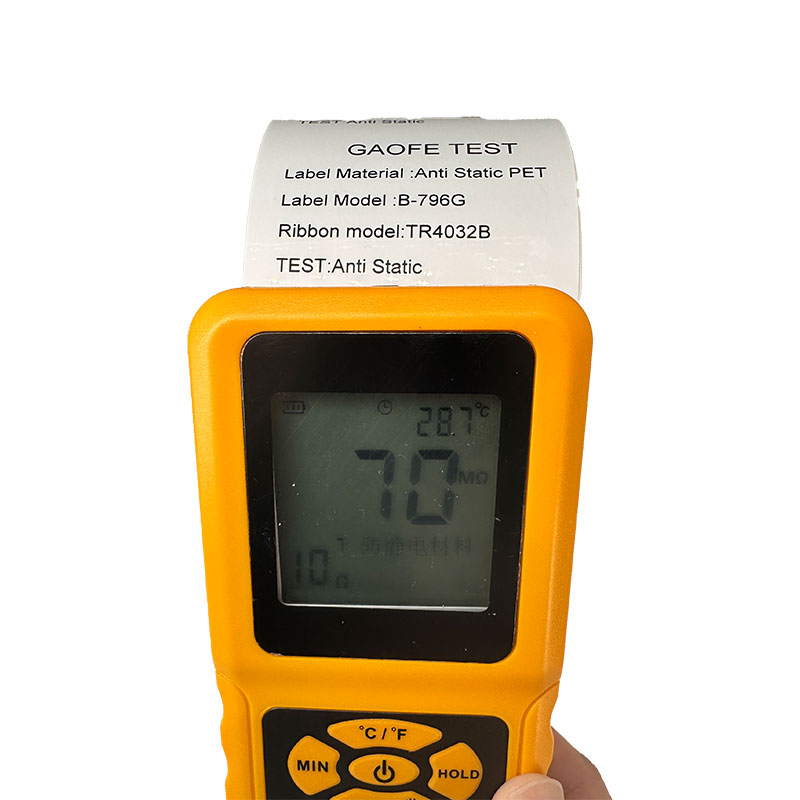
Product-page test photograph. Confirm the method, conditions, and supporting report for the requested specification.
A photograph of an instrument reading is not a substitute for a complete test report.
Validate the Label on the Actual Surface
Test adhesion, printing, readability, and removal behavior where relevant.
Include the actual surface preparation, application temperature, exposure conditions, and waiting period before testing. If the label must pass through a thermal process, provide the complete time–temperature profile.
Do not assume that a PET label intended for electronics identification is suitable for every reflow, cleaning, or long-term exposure condition.
Send a Complete Quotation Brief
| Information to provide | Details needed |
| Application | PCB, component, tray, packaging, or other surface |
| Label dimensions | Width, height, shape, and tolerances |
| Construction | Required film, adhesive, liner, and ESD properties |
| Printing | Blank or printed, artwork, data, barcode, and ribbon where applicable |
| Roll format | Core, outside diameter, winding, gaps, and quantity per roll |
| Order plan | Initial quantity, repeat demand, and number of variations |
| Validation | Tests, reports, samples, and acceptance criteria |
| Delivery | Destination and requested delivery basis |
To obtain a product-specific price, contact GAOFE with your electronic label specification. Include a drawing or sample, expected quantity, printing method, and application conditions so the quotation can be prepared on a clear basis.
FAQ
1. Is there a standard price for electronic labels?
No single price covers all sizes, materials, printing requirements, and quantities. Compare quotations for a defined specification and separate additional charges.
2. Are ESD labels the same as ESD warning stickers?
Not necessarily. A warning sticker communicates a message. An ESD-specific label construction must meet the electrical and application requirements agreed for its intended use.
3. Is a blank label always cheaper than a printed label?
Its purchase price may be lower, but printing consumables, labor, setup, and losses remain. Compare the cost of a usable finished label.
4. Can one label material be used throughout PCB production?
Not automatically. Thermal, chemical, adhesion, and static-control requirements can differ between process stages. Validate the proposed construction for each intended use.
5. How can buyers reduce cost without changing the required performance?
Review standard sizes, efficient layouts, consolidated artwork, suitable order quantities, and compatible printing settings. Approve samples before changing any material or process requirement.


