Label failure in cold environments causes severe operational disruptions across multiple sectors. Unidentifiable laboratory samples, rejected cold-chain shipments, and lost inventory directly impact project timelines, regulatory compliance, and overall supply chain integrity. Standard adhesives crystallize, harden, and lose tack in sub-zero environments. Condensation, high humidity, and frost actively repel standard labeling solutions, creating physical barriers that prevent adhesion. Facilities must engineer low temperature labels specifically for the environment. This requires aligning three variables: application temperature, service temperature, and substrate material. Understanding these factors ensures tracking systems remain intact from blast freezers to cryogenic storage. We evaluate adhesive chemistry, select durable face stocks, and implement application strategies that guarantee long-term adhesion and barcode readability in freezing conditions.
Application vs. Service Temperature: The temperature at the exact moment of label application dictates the required adhesive formulation, which often differs from the long-term storage (service) temperature.
Adhesive Chemistry is Non-Negotiable: Standard rubber-based adhesives fail in cold storage; specialized acrylic, solvent-based, or cryogenic adhesives are mandatory for sub-zero reliability.
Substrate and Curvature Matter: The surface material (glass, corrugated plastic, cardboard) and its shape (small radius vials vs. flat pallets) drastically alter adhesive performance in freezing conditions.
Testing is Mandatory: Because environmental variables (humidity, frost, blast-freezing speeds) vary by facility, in-situ testing of industrial labels is a required procurement step.
How to Choose Cold Storage Labels
Application Temperature vs. Service Temperature
Application temperature defines the environmental and surface temperature at the exact moment you apply the label. This metric dictates the initial tack required for the adhesive to grab the substrate. Applying a label to an already-frozen surface requires a highly aggressive, specialized initial tack. The adhesive must flow and grip the microscopic pores of the material before the ambient cold halts its movement. If the adhesive is too rigid at the time of application, it rests on top of the surface without forming a bond.
Service temperature represents the temperature range the label must endure after the adhesive has fully cured. Curing typically takes 24 to 72 hours, depending on the ambient environment, during which the adhesive achieves its maximum bond strength. Facilities often fall into a common evaluation trap: procuring a label rated for a -40°C service temperature, but failing to realize it requires a minimum +5°C application temperature to properly bond. If operators attempt to apply this label inside a -10°C freezer, the adhesive fails immediately, regardless of its impressive service temperature rating.
| Scenario | Application Environment | Service Environment | Adhesive Requirement |
| Standard Cold Chain | Loading Dock (+15°C) | Commercial Freezer (-20°C) | Standard freezer-grade acrylic. High service range, standard application. |
| Blast Freezing | Processing Floor (+5°C) | Blast Freezer (-40°C) | Aggressive solvent-based. Fast wet-out required before rapid freeze. |
| In-Freezer Application | Inside Freezer (-20°C) | Inside Freezer (-20°C) | Specialized "all-temp" or frozen-surface adhesive. High initial tack at sub-zero. |
| Cryogenic Lab Storage | Laboratory Bench (+22°C) | Liquid Nitrogen (-196°C) | Cryogenic polymer blend. Extreme service range required post-cure. |
Why Standard Industrial Labels Fail in Freezing Conditions
Standard adhesives hit a glass transition phase when exposed to cold environments. Every adhesive has a specific Glass Transition Temperature (Tg). As temperatures drop below this threshold, the polymers within standard adhesives harden, crystallize, and ultimately shatter under microscopic stress. They lose all elastomeric properties, transforming from a flexible, tacky substance into a rigid, glass-like layer. Once this transition occurs, any movement, vibration, or substrate expansion causes the adhesive bond to fracture, resulting in the label falling off the substrate.
Moisture, frost, and high humidity act as a physical barrier in cold storage environments. These elements sit directly between the adhesive and the substrate. This prevents proper wet-out, meaning the adhesive never actually touches the surface it is meant to grip. Instead, it bonds to the microscopic layer of ice. When that ice shifts, melts, or sublimates, the label detaches entirely. You cannot bond a label to water and expect it to hold onto the box underneath.
Thermal shock plays a critical role in label failure. A rapid transition from room temperature to a blast freezer causes face stock expansion and contraction. This sudden dimensional movement breaks the fragile adhesive bond, especially if the face stock material is rigid and unable to flex with the substrate. Different materials expand and contract at different rates. If a rigid paper label is applied to a flexible plastic tote, the tote will shrink in the cold faster than the paper, causing the label to buckle and pop off.
The Impact of Extreme Thermal Cycling
Certain environments require labels to survive extreme heat immediately followed by extreme cold. Laboratory vials often undergo autoclave sterilization at +130°C under high pressure steam to ensure a sterile environment before entering cryogenic freezing at -196°C. This massive temperature swing places immense stress on both the adhesive and the face stock.
Rapid temperature swings cause severe adhesive shear. They create dimensional instability in standard face stocks, leading to shrinking, warping, or curling at the edges. You need specialized polymer blends to handle these massive thermal shifts. The adhesive must remain stable during high-heat exposure without melting, oozing, or losing its chemical structure, and then immediately transition to a flexible state to survive the deep freeze without crystallizing.
Core Adhesive Technologies for Low Temperature Labels
Freezer-Grade Acrylic Adhesives
Freezer-grade acrylic adhesives utilize water-based or solvent-based acrylics modified specifically for cold-temperature flexibility. Manufacturers engineer these acrylics to maintain their elastomeric properties well below freezing, ensuring the adhesive continues to flow and grip the substrate even as the ambient temperature drops.
These adhesives serve as the ideal choice for general cold storage, commercial refrigeration, and environments with high humidity. They typically maintain strong adhesion from 0°F down to -40°F (-18°C to -40°C). They offer excellent UV resistance and do not yellow over time, making them suitable for long-term storage tracking in warehouses with skylights or outdoor holding areas.
Freezer-grade acrylics have limitations. They struggle with application on heavily frosted surfaces where moisture creates a thick barrier. Extremely rough corrugated cardboard can prevent adequate bonding, as the standard acrylic coat weight may not be thick enough to fill the deep crevices of the rough texture. In these cases, a higher coat weight is required to ensure enough adhesive mass exists to grab the peaks and valleys of the cardboard.
Solvent-Based Adhesives
Solvent-based adhesives are permanent formulations utilizing solvent carriers to bite into challenging substrates. The solvent temporarily softens the surface of certain plastics and coatings, allowing the adhesive to integrate deeply and form an incredibly strong, near-permanent bond. This chemical bite provides superior anchorage compared to standard surface-level adhesion.
These adhesives are ideal for plastics, glass, and environments requiring aggressive initial tack on cold surfaces. Blast freezers and outdoor winter logistics yards are prime examples where solvent-based options excel. They cut through minor surface contamination, thin oil films, and light moisture better than standard acrylics.
The primary limitations include higher material costs and environmental considerations. There are potential outgassing concerns in highly sensitive cleanroom environments or specific laboratory settings where volatile organic compounds (VOCs) must be strictly controlled. Solvent adhesives also require careful matching to the substrate, as highly aggressive solvents can damage or warp very thin plastic films.
Cryogenic Adhesives
Cryogenic adhesives feature highly specialized polymer blends designed to survive ultra-low temperatures without degrading. These formulations maintain flexibility and structural integrity in environments that would instantly shatter standard adhesives. They are engineered to have an exceptionally low Glass Transition Temperature.
They are the mandatory choice for liquid nitrogen storage (-196°C), deep-freeze laboratory environments, and multiple freeze-thaw cycles. They handle high-heat sterilization seamlessly, making them indispensable for medical research, biobanking, and genetic material storage where sample identification is a matter of strict regulatory compliance.
Despite their superior performance, cryogenic adhesives are over-engineered and cost-prohibitive for standard commercial freezer applications. Using them for basic cold-chain logistics or standard food refrigeration represents an unnecessary expenditure. Reserve cryogenic solutions strictly for environments dropping below -80°C.
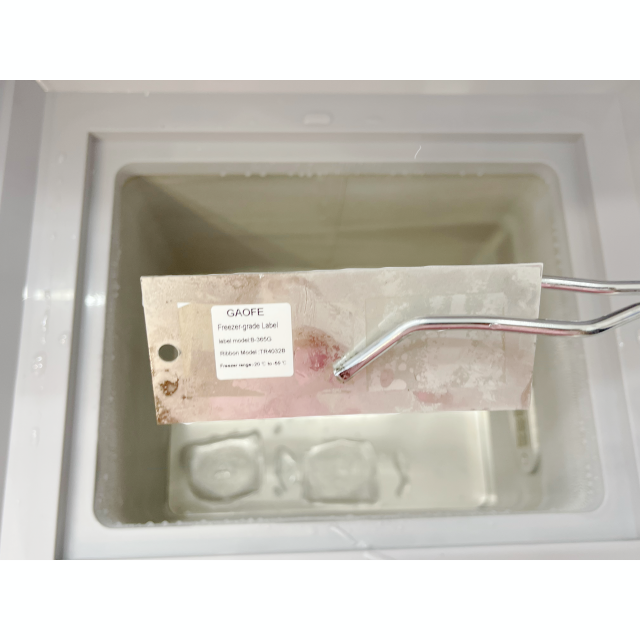
Face Stock Materials: Matching Durability to Environment
Synthetic Materials (Polyester/PET and Polypropylene/BOPP)
BOPP (Biaxially Oriented Polypropylene) works exceptionally well for general freezer applications. It offers excellent moisture resistance, preventing the label from becoming soggy or deteriorating in high-humidity refrigeration units. BOPP provides good flexibility, allowing it to conform to slightly curved surfaces like plastic jugs or thick cables. It remains highly cost-effective for large-scale cold-chain logistics, warehouse racking, and food packaging.
PET (Polyester) suits extreme environments where maximum durability is required. It delivers superior chemical resistance, protecting printed data from harsh laboratory solvents like xylene, ethanol, and DMSO. PET maintains incredible dimensional stability during rapid temperature shifts, ensuring the label does not shrink or warp during autoclave-to-freezer cycling. This makes it the ideal face stock for cryogenic lab vials, printed circuit board tracking, and heavy industrial asset management.
Paper-Based Face Stocks
Coated paper labels work adequately for dry, short-term cold storage. Temporary logistics routing labels, inventory tags, and short-cycle shipping labels often utilize paper effectively to keep material costs low. When paired with a freezer-grade adhesive, they perform well in controlled, dry environments where temperature fluctuations are minimal.
Paper has a critical vulnerability. It absorbs condensation during freeze-thaw cycles and high-humidity refrigeration. This moisture absorption leads to structural degradation, tearing, and smudging. Once the paper breaks down, barcodes become unreadable, causing severe scanning failures and inventory tracking blind spots. Never use paper face stocks for long-term cold storage or environments subject to frequent temperature cycling.
Print Method Compatibility
Thermal transfer printing requires matching the ribbon to the synthetic face stock. Wax/resin or full resin ribbons create smudge-proof, cold-resistant barcodes that withstand handling, frost, and condensation. Full resin ribbons paired with PET face stocks offer the highest level of durability against both extreme cold and chemical exposure. The heat from the printhead melts the resin directly into the synthetic face stock, creating a permanent bond that resists scratching and fading.
Direct thermal labels carry significant risks in cold environments. The heat-sensitive coating is prone to fading and remains highly sensitive to ambient handling post-thaw. Friction, moisture, and UV exposure can quickly render direct thermal barcodes unreadable. They offer operational convenience for short-term cold logistics where longevity is not required and ribbon replacement slows down high-volume printing operations, but they fail in long-term archival storage.
| Print Method | Ribbon Type | Best Face Stock | Cold Storage Durability |
| Direct Thermal | None | Coated Paper | Low. Fades with friction, moisture, and UV exposure. Short-term only. |
| Thermal Transfer | Wax | Paper / Matte BOPP | Moderate. Good for dry cold, but smudges under heavy condensation. |
| Thermal Transfer | Wax/Resin | BOPP / Synthetic | High. Excellent moisture resistance and scratch durability in freezers. |
| Thermal Transfer | Full Resin | PET (Polyester) | Extreme. Survives liquid nitrogen, autoclaves, and harsh chemicals. |
Application-Specific Evaluation Frameworks
Laboratory and Healthcare (Cryogenic Storage)
Laboratory environments demand labels that meet strict success criteria. They must guarantee adhesion to small-diameter glass and polypropylene vials without flagging. Survival in both liquid nitrogen and vapor phase storage is non-negotiable. The labels require resistance to common laboratory chemicals like ethanol, xylene, and DMSO, which are frequently used during sample preparation. They must withstand autoclave-to-freezer thermal cycling without losing structural integrity or barcode legibility.
The recommended configuration for these demanding environments is a cast vinyl or PET face stock paired with a cryogenic solvent-based adhesive. This combination ensures the label conforms to tight radiuses and remains permanently affixed through decades of deep-freeze storage. The thin profile of cast vinyl prevents the material memory from fighting the adhesive on small test tubes.
Food and Beverage Cold Chain
The food and beverage cold chain requires labels that navigate high humidity and rapid freezing processes. Success criteria include FDA compliance for indirect or direct food contact, depending on the application. The labels must demonstrate the ability to adhere to waxed corrugated boxes, shrink-wrap, and textured plastics. Survival through blast-freezing processes and high-humidity refrigeration units is essential for maintaining supply chain visibility and meeting strict grocery compliance standards.
The recommended configuration for food logistics is a BOPP face stock with an aggressive freezer-grade acrylic adhesive. This provides the necessary moisture resistance and initial tack to grip cold, slightly damp packaging materials reliably. A higher adhesive coat weight is often specified to ensure the label can bite through the wax coatings commonly found on poultry and seafood boxes.
Heavy Industrial and Outdoor Winter Environments
Heavy industrial applications face unique challenges in sub-zero conditions. Success criteria involve adhesion to rough, dirty, or oily surfaces. Metal drums, treated lumber, and structural steel in sub-zero outdoor yards demand robust solutions. UV resistance must pair alongside cold resistance to prevent the face stock from becoming brittle, yellowing, and cracking under harsh winter sunlight.
The recommended configuration relies on heavy-duty polyester Industrial labels with high-coat-weight solvent adhesives. The thicker adhesive layer fills the gaps in rough surfaces, while the PET face stock withstands physical abrasion, forklift impacts, and environmental weathering. These labels often utilize a matte finish to reduce glare for barcode scanners operating in bright snowy conditions.
Implementation Risks and Mitigation Strategies
Managing Frost and Condensation on Substrates
Micro-layers of ice and high ambient humidity present a major risk during application. They prevent the adhesive from wetting out on the substrate, causing the label to bond to the frost rather than the physical item. When the frost melts or shifts during transport, the label falls off entirely, leaving the product unidentified.
Specify "all-temp" or "wet-stick" adhesives designed to displace moisture and cut through thin layers of condensation. Implement strict operational protocols requiring staff to wipe surfaces completely dry with a clean cloth immediately prior to application. Removing the physical barrier is the most effective way to ensure a permanent bond. If wiping is impossible due to operational speed, you must rely on high-tack hot-melt adhesives formulated specifically for wet conditions.
Surface Tension and Curvature Challenges
Flagging or peeling at the edges occurs when stiff labels are applied to tight curves in cold environments. Test tubes, vials, and small-diameter piping often experience this failure. The rigidity of the face stock fights against the adhesive, pulling the edges away from the curved surface before the adhesive can fully cure. Cold temperatures exacerbate this by slowing down the adhesive curing process, giving the stiff face stock more time to pull away.
Select highly conformable face stocks like flexible vinyl or thin BOPP. Ensure the adhesive coat weight is sufficient to hold the curve during the initial curing phase. Applying pressure evenly across the entire surface of the label helps set the adhesive and prevents the edges from lifting. Use a mandrel hold test during the procurement phase to verify the label will not flag on your specific vial diameters.
Storage and Handling of Unused Labels
Storing rolls of labels in the freezer degrades the adhesive before it is ever applied. Prolonged exposure to cold temperatures while still on the liner causes the adhesive to harden prematurely, destroying its initial tack and rendering the roll useless. Operators often make the mistake of leaving label rolls on carts inside the cold storage facility overnight.
Outline strict storage protocols to protect your inventory. Store unused rolls at room temperature, ideally between 68°F and 72°F (20°C to 22°C). Keep them in their original packaging, sealed in plastic bags to prevent moisture ingress. Store them away from direct sunlight and high humidity to preserve shelf life and ensure maximum adhesive efficacy when needed. Only bring the labels into the cold environment at the exact moment of application.
Conclusion
Audit your facility's exact application and service temperatures using calibrated infrared thermometers to establish accurate baseline requirements.
Request material sample rolls from manufacturers to conduct 72-hour in-situ testing on your specific substrates inside your actual freezers.
Implement a strict room-temperature storage protocol for all unused label inventory to prevent premature adhesive degradation before application.
Standardize surface wipe-down procedures on the warehouse floor to eliminate micro-frost barriers prior to label application.
FAQ
Q: What is the difference between freezer-grade and cryogenic labels?
A: Freezer-grade labels typically maintain adhesion down to -40°C and are designed for standard cold storage and commercial refrigeration. Cryogenic labels feature specialized polymer adhesives engineered to survive ultra-low temperatures down to -196°C, making them suitable for liquid nitrogen storage and deep-freeze laboratory environments.
Q: Can low temperature labels be applied to already frozen surfaces?
A: Yes, but it requires specific frozen-surface adhesives with an extremely aggressive initial tack. Standard cold-storage labels usually require room-temperature application before being placed in the freezer. Applying labels to already frozen items demands specialized formulations that can grip through micro-condensation.
Q: Can cold storage labels survive high heat or sterilization?
A: Specific cryogenic and extreme-temperature labels are engineered to survive autoclave sterilization at +130°C before being plunged into freezing temperatures. Standard freezer labels will melt or warp under high heat, so you must specify thermal-cycling capabilities if sterilization is required.
Q: Why do standard industrial labels peel off in the freezer?
A: Standard adhesives reach their glass transition temperature in freezing conditions, causing them to crystallize, harden, and shatter. High humidity and frost create a physical barrier on the substrate, preventing the adhesive from making direct contact and wetting out properly.
Q: Are direct thermal labels suitable for cold storage?
A: Direct thermal labels can work for short-term, dry cold storage logistics. They are prone to fading from friction and moisture. For long-term durability, moisture resistance, and reliable barcode scanning post-thaw, thermal transfer printing on synthetic face stocks is highly recommended.
Q: How long does it take for freezer label adhesive to cure?
A: Most freezer label adhesives require a standard 24 to 72-hour dwell time to achieve maximum bond strength. Cold temperatures slow down the adhesive flow and wet-out process, making it critical to allow sufficient curing time before subjecting the label to heavy handling or extreme thermal shock.


